Preparation
Assessing your health, reviewing your medical history and planning for individual risks before your procedure are part of the specialist work involved in your care.

When a patient receives an anaesthetist’s bill, their first question is often how much they’ll need to pay. Their out-of-pocket cost is the amount left after any contributions from Medicare and private health insurance.
Understanding that cost means looking beyond the bill: at the specialist care provided, the fee charged and the funding available. Having private health insurance doesn’t always mean having the full cost covered.
Your anaesthetist’s care goes well beyond the operating room. Discover their role before, during and after your procedure, what Medicare and your private insurer contribute, and why you may be left paying a gap.
Medicare rebates and health insurance arrangements need to keep pace with the care Australians rely on. We’re calling for reform that recognises the cost of specialist care and helps reduce what patients pay out of pocket.
More than four million operations a year involve anaesthesia in Australia.
The anaesthetist’s fee reflects the specialist expertise, time and resources needed to provide care. It takes account of the preparation involved, the length and complexity of procedure, and the cost of maintaining a safe, well-supported practice.
Assessing your health, reviewing your medical history and planning for individual risks before your procedure are part of the specialist work involved in your care.
The length of your procedure affects the time needed for anaesthetic care and monitoring. Assessment, preparation and care during recovery also form part of your anaesthetist’s work.
More complex procedures can require more intensive care and monitoring. Some may also require more than one anaesthetist.
Providing safe specialist care involves ongoing training, professional insurance, equipment, technology and support staff. These are part of the cost of maintaining an anaesthetic practice and caring for patients.
Source: Australian Society of Anaesthetists. Specialist Fees and Patient Out-of-Pocket Costs – Summary Report (opens in a new tab), April 2026, p. 7 (Q9; n = 1,121).
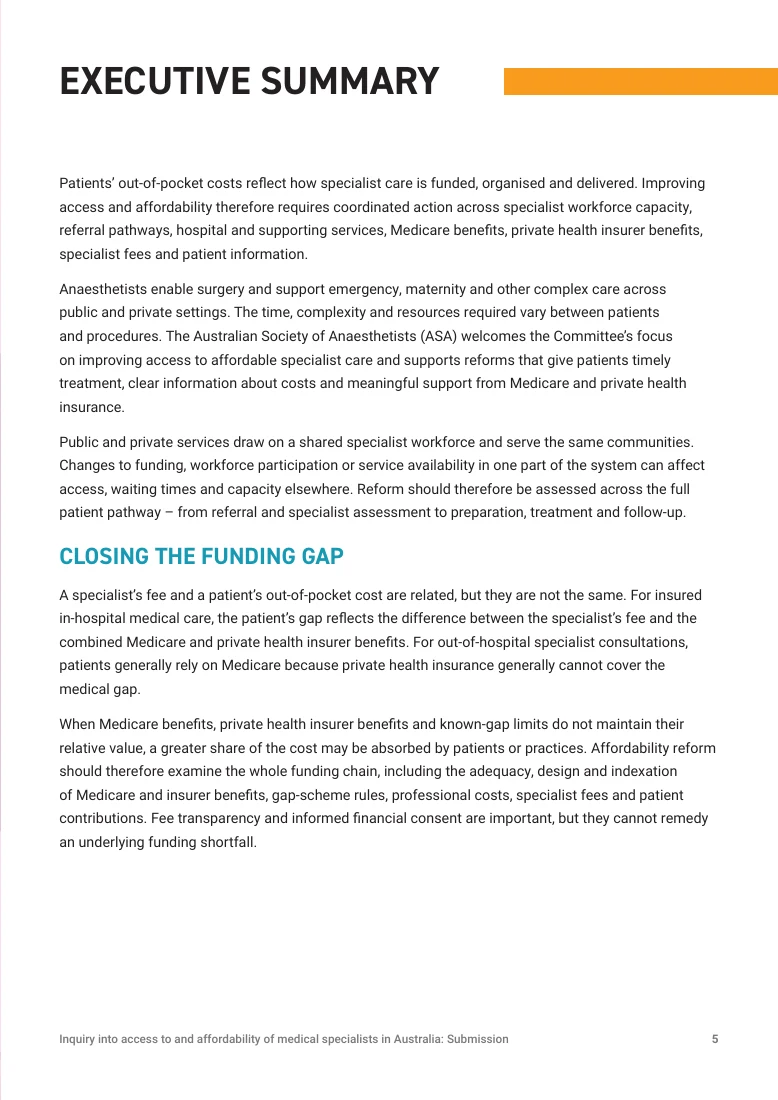
Medicare and private health insurance may cover part of your anaesthetist’s fee. What remains is your out-of-pocket cost – the gap you pay.
The size of that gap depends on the fee charged, what Medicare and your insurer contribute, and the gap arrangements that apply.
Reducing out-of-pocket costs requires action on both the payments towards care and the rules that govern them. We’re calling for:
Medicare rebates that reflect the cost of anaesthetic care, with predictable, regular increases.
Higher insurer payments to patients for anaesthesia, updated regularly as the cost of providing care changes.
Known-gap limits reviewed and indexed alongside insurer payments, to help keep care within gap arrangements.
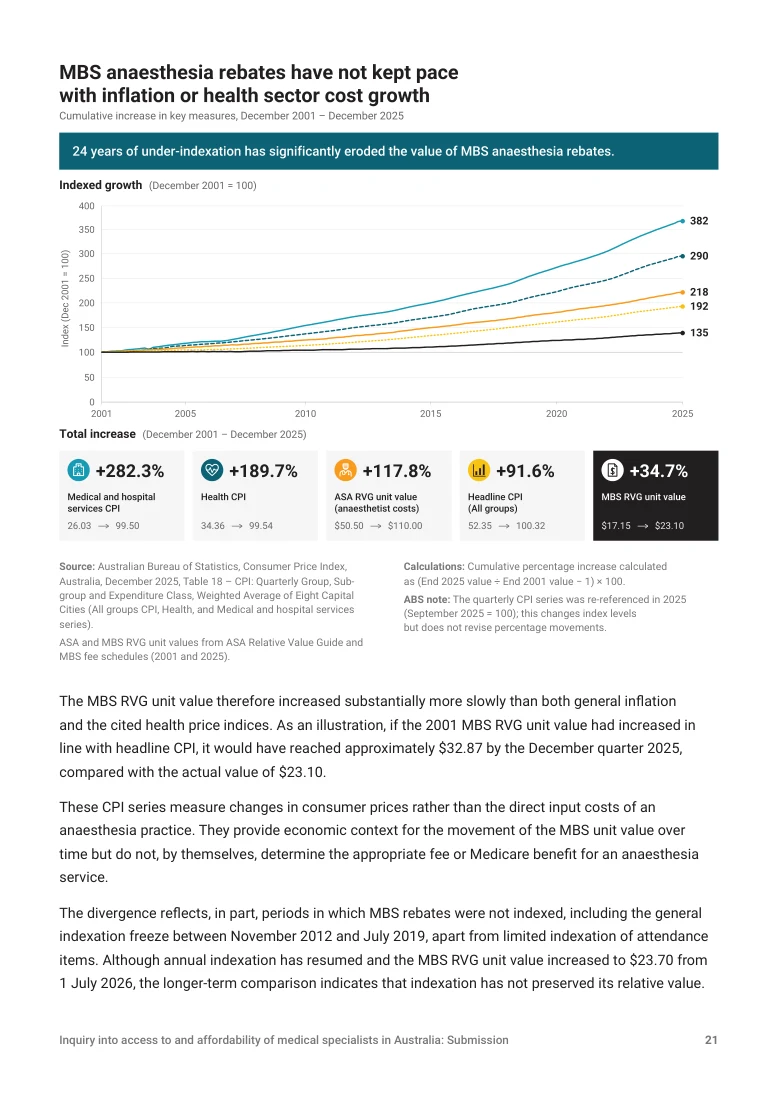
Rate per RVG unit (AUD)
The inflation comparison is in December 2025 dollars; the actual Medicare rate is for July 2026.
Medicare rebates help Australians afford specialist care. When those rebates fall behind rising costs, patients can be left paying more of the difference.
Medicare uses a unit-based schedule to calculate anaesthesia rebates. Its base rate rose from $17.15 in 2001 to $23.70 in July 2026. ASA’s inflation comparison puts the 2001 rate at approximately $32.90 in December 2025 dollars – already above the July 2026 rate.
We’re calling for Medicare’s anaesthesia rebates to be reviewed and regularly indexed to better reflect the cost of providing care.
2025 rate per RVG unit (AUD)
Medicare + insurer payments range from $36.70 to $43.00 across selected gap-cover products. These are rates per unit, not the total cost of a procedure.
Patients pay premiums expecting their private health insurance to help cover their care. The amount an insurer contributes – and the conditions attached to that payment – directly affects how much the patient has left to pay.
Private health insurer payments for anaesthesia have fallen behind the cost of providing care. When those payments fall short, patients can face a larger gap, or anaesthetists must absorb more of the cost.
These are rates per anaesthesia unit, not the total cost of a procedure. ASA’s benchmark guides fee setting but it does not set the fee your anaesthetist charges.
We’re calling on private health insurers to increase their payments to patients for anaesthesia and update them regularly as the cost of providing care changes.
No-gap arrangements allow eligible care to be provided without an out-of-pocket cost for the doctor’s service. Known-gap arrangements limit the amount the patient pays. Both depend on doctors charging within limits set by insurers.
Known-gap limits have not increased in 25 years. As practice costs rise, providing care within these arrangements becomes harder. If care falls outside an arrangement, patients may face a larger gap despite having private health insurance.
Known-gap limits need regular review and indexation alongside insurer payments. These changes should work together to help keep care within gap arrangements and reduce what patients pay out of pocket.
In ASA’s national survey, 84% of anaesthetists surveyed participated in no-gap, known-gap or both types of arrangements. Helping patients manage costs was a major reason for taking part.
That commitment needs to be matched by Medicare and private health insurers contributing amounts that keep pace with the care patients need.
Whether it’s 4am or 4pm, Australians need access to safe anaesthetic care. Meeting that need takes a workforce ready to respond and a funding system that keeps care affordable.
Australia’s need for anaesthetic care is growing. ASA workforce modelling projects a 5.7% workforce shortfall by 2032 under its base scenario. Meeting that demand means supporting the specialists who provide care across both public and private facilities.
Medicare rebates and private health insurer payments need to reflect the cost of providing that care. Bringing them up to date can help reduce pressure on patients while supporting the services Australians rely on.
Patients already contribute to Medicare through their taxes, and those with private health insurance pay premiums for their cover. They should be able to rely on that support when they need specialist care.
Reform must address affordability and workforce capacity together – so Australians can access safe specialist care, now and into the future.
Patients need Medicare rebates and private health insurance arrangements that keep pace with the cost of specialist care. Ask your federal MP to support reforms that help reduce out-of-pocket costs and protect access to anaesthesia.
Your anaesthetist is a specialist doctor whose care begins before your procedure and continues into recovery. They assess your health, plan your anaesthetic, monitor you throughout your procedure and help manage your recovery.
Their expertise supports your safety at every stage – even when you’re unaware of the care they’re providing.
(opens in a new tab)
‘Beyond the Bill’ is a campaign from the Australian Society of Anaesthetists (ASA).
The Australian Society of Anaesthetists was formed in 1934 and is a member-funded organisation dedicated to supporting, representing and educating specialist anaesthetists to ensure the safest possible anaesthesia for the community. We have proudly supported specialist anaesthetists for over 90 years and continue to support members and advance their skills while advocating for the anaesthesia specialty to ensure safe and high-quality patient care for the Australian public.
Specialist anaesthetists engage with patients at critical moments of care and provide anaesthesia services across a wide range of settings. Australian anaesthetists deliver care to recognised clinical and safety standards within the Australian healthcare system. In the private sector alone, Australian anaesthetists provide more than 7,000 episodes of care each day, generating valuable insights into the patient journey.